

STOP #2
STOP #2
STOP #2
Listen to the Audio
Pterocarpus Tree
The Pterocarpus Living beings depend on their adaptations for their survival in our very competitive environment. Pterocarpus officinalis, the tree that predominates in the Forest, is a unique example of extreme adaptations.
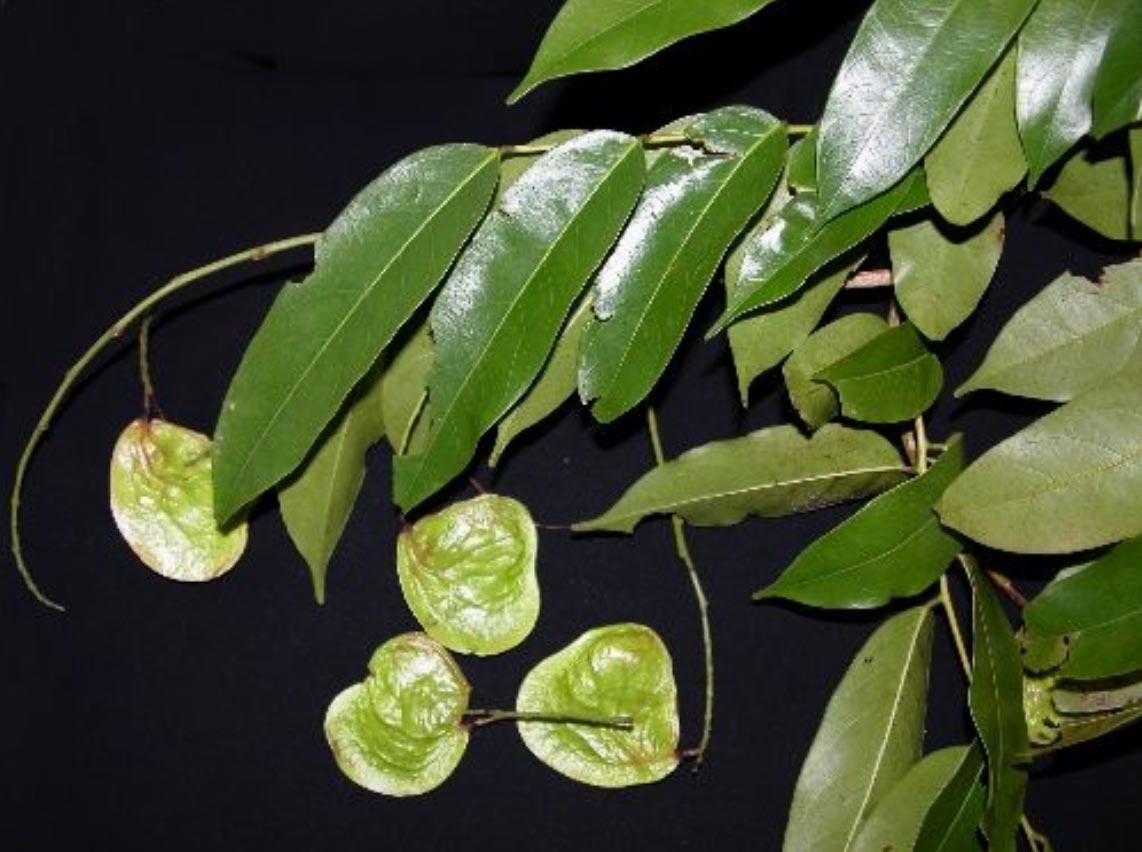
Pterocarpus officinalis is known as ‘Palo de pollo’ in Puerto Rico, because its aerial roots can look like chicken feet, and as Bloodwood in English, because of its sapwood. It is an evergreen tree that reaches 130 feet in height and 23 to 35 inches in diameter at breast height, at maturity. Characteristics of Pterocarpus officinalis include sinuous, narrow and large buttresses; a very light wood; a dark red latex that is exuded from the cuts in the cortex; compound, alternate leaves and odd-pinnate leaves; and flat, round and winged pods.
The name “Pterocarpus” is derived from the Greek “ptero”, which means wings or winged (as in Pterodactyl, the flying pterosaur/dinosaur) and “carpos” which means “fruit”. This is so because of the peculiar shape of its fruit.
The Bloodwood grows in coastal marshes, including fresh and brackish water marshes, on the inland side of the mangroves, and along the banks of streams.
The buttressed roots penetrate centimeters into mud devoid of oxygen, an environment where other trees cannot grow. Despite its adaptations, Pterocarpus forests were almost eliminated, as its swamps were drained and filled for the production of sugar cane and other agricultural products, as well as for the construction of buildings.
Uses of Pterocarpus
During the 19th century, in Puerto Rico, the buttresses of the Pterocarpus tree were used to make plates which were used to separate gold in water.
Until recently the latex produced by the Pterocarpus was exported from Colombia to Spain under the name “dragon’s blood” to be used as a hemostatic medicinal agent and astringent. It has also been used as a
disinfectant.